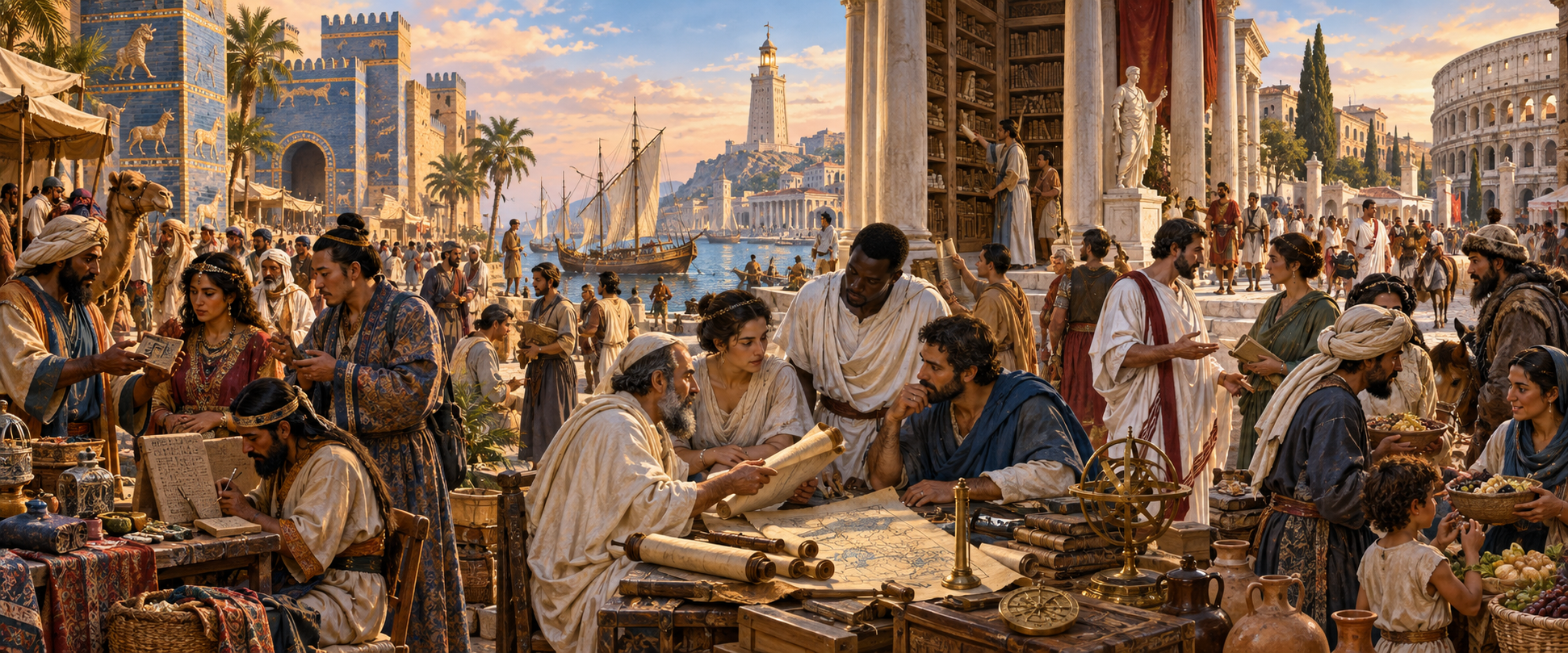
Babylon, Alexandria, and Rome were multicultural cities thousands of years before the modern world gave multiculturalism a name.
Their streets carried many languages. Their markets offered goods from distant regions. Their temples, libraries, workshops, and public squares brought together people of different origins, customs, beliefs, and ways of understanding life.
These cities remind us of something both ancient and enduring: wherever human beings of different backgrounds are able to live, meet, and participate, many forms of wealth can emerge.
Not wealth in the narrow sense of property, but wealth in the meaning of knowledge, craft, language, memory, imagination, culture, and wisdom.
No civilization has ever been created by one kind of person alone. Babylon grew through encounters among different peoples, traditions, and empires. Alexandria became a meeting place for Egyptian, Greek, Jewish, African, Mediterranean, and Near Eastern worlds. Rome absorbed influences from nearly everywhere it reached, adopting and transforming the ideas, religions, techniques, foods, stories, and artistic forms of the people it encountered.
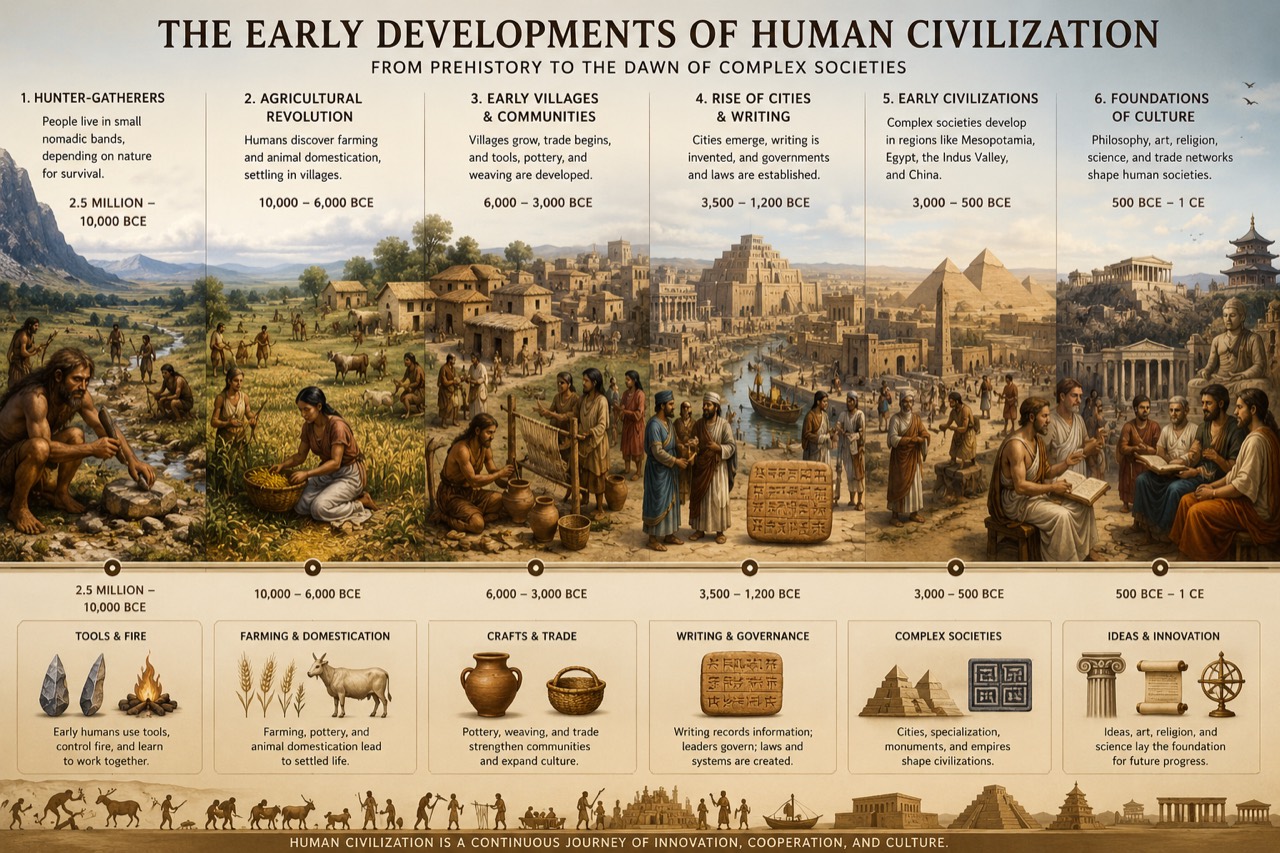
These cities were not harmonious utopias. They developed through conquest and slavery, and there was prejudice and inequality. Yet even within their contradictions, they demonstrate that civilizations become richer through the contributions of humans of all kinds. Ideas travel with people. So do skills, questions, recipes, melodies, medicines, mathematical insights, spiritual traditions, and ways of seeing the world.
Every person carries more than an individual identity. Each carries fragments of history: words inherited from ancestors, habits shaped by a community, lessons learned through hardship, and possibilities that may not yet have found expression. When people meet, these inheritances meet as well. Sometimes they clash. Sometimes they merge. Sometimes one tradition illuminates what another could not see by itself. Out of such encounters, something new can appear.
Much of what a society considers its own is therefore the result of countless contributions from different people and cultures. Languages grow through encounters between communities, carrying words, meanings, and ways of thinking from one generation and one people to another. Philosophies develop through argument and translation. Scientific knowledge passes across borders and generations. Art is renewed through unfamiliar forms. Even ordinary life—the food on a table, the numbers used in calculation, and the stories told to children—is filled with gifts received from other people.
If human beings of many backgrounds are living in a place—if they are permitted not only to exist but also to speak, create, teach, remember, and participate—then the wealth of human possibility is present there as well. The decisive question is whether a society recognizes and values it.
Civilizations should welcome the contributions of diverse peoples while also accepting the people themselves. They should value art and knowledge while honoring those who create and carry them. They should benefit from migrant labor while respecting the dignity and rights of migrants. They should preserve cultural treasures without forgetting the travelers, workers, scholars, and translators through whom those treasures arrived.
Culture, knowledge, and wisdom do not come from nowhere. They are given by people: by merchants and wanderers, mothers and teachers, artisans and scholars, migrants and refugees, servants and rulers, believers and doubters. They are given by human beings of every appearance, origin, condition, and name.
To honor humanity is therefore also to honor the many sources of civilization. It is to understand that no group possesses all wisdom and no culture contains every answer. Every people has something to teach, and every people has something to learn. Our shared world becomes more abundant when human experience is allowed to speak in many voices.
The great cities of antiquity have been destroyed, changed, or have survived in forms their inhabitants could not have imagined. But the principle remains: wherever human beings encounter one another, worlds encounter one another.
When those encounters are met with curiosity, dignity, and openness, the result can be a wealth greater than anything stored in all the treasuries—the accumulated wealth of humanity giving itself to humanity.